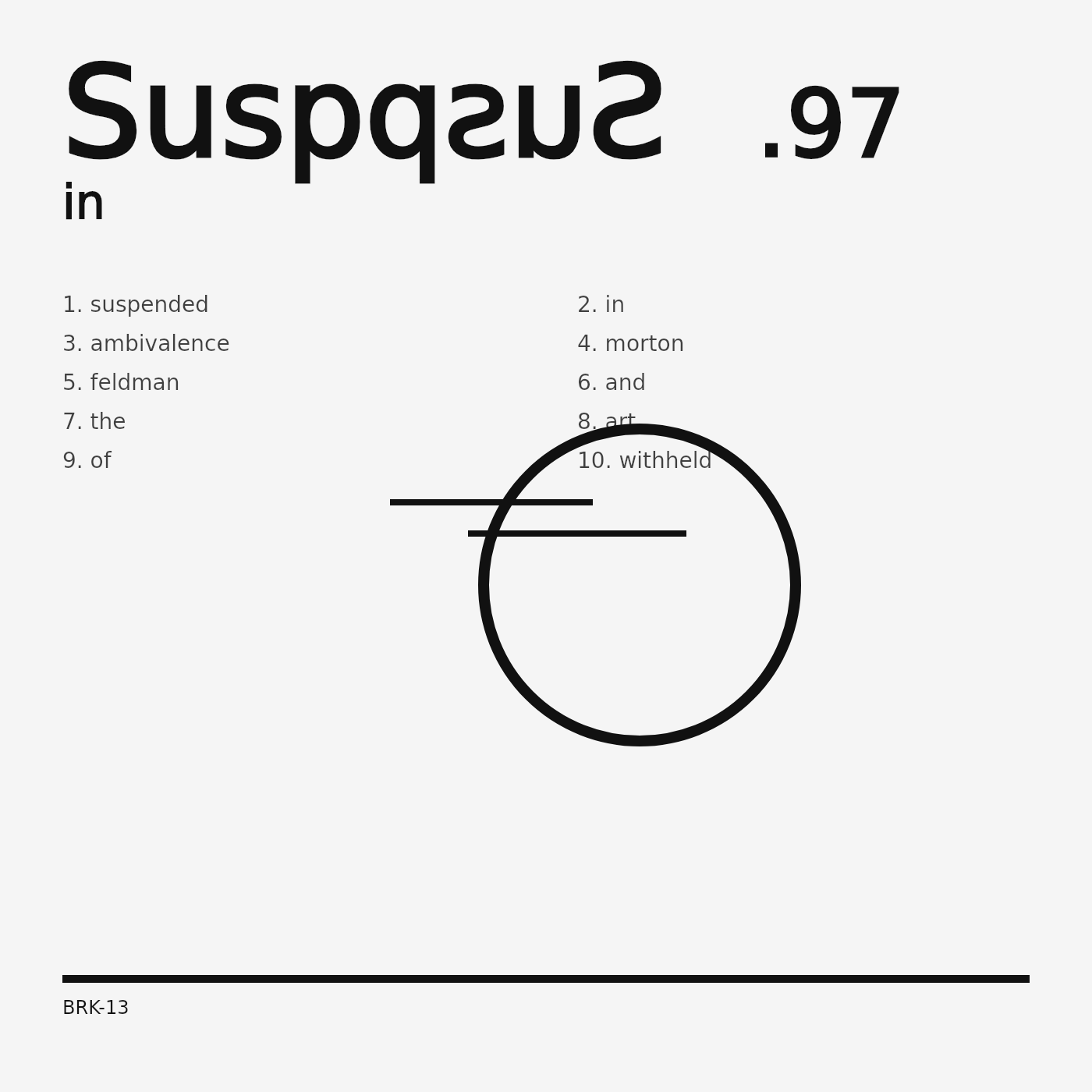
The shadow of a parliament’s hesitation lingers as I reflect upon Morton Feldman’s approach to musical time: a reluctance not just to conclude, but to decide at all. Feldman’s compositions operate at a threshold between movement and stasis, notably in the slow, quiet patterns he crafts for electric piano and soft percussion. It is the absence of teleology—a refusal to press onward to the ‘next’—which renders his work so distinct within the tradition of ambient music.
Technically, Feldman’s scores invite performers to enter a zone where dynamic marks are whispers, and the durations, written as unfixed time brackets, pivot on the performer's patience. One can, for example, observe in “For Bunita Marcus” the use of sparse, widely spaced chord voicings on the piano. Here, the use of una corda and an extremely gentle touch diminishes attack, allowing tones to shimmer at the very threshold of perception. Each note is a hesitant proposition, its decay a lingering pause in which the listener dwells, uncertain whether to desire continuation or cessation.
This measured indeterminacy is not, as some have suggested, a lack of decision, but rather an active cultivation of ambiguity. Feldman orchestrates tension through absence, a kind of musical aperture in which the possibility of change remains present yet perpetually deferred. The effect is a perpetual negotiation—an unresolved referendum—between inertia and momentum. The music draws us into a state of profound receptivity, attentive to nuances that too swift a judgement would simply erase.
Charlotte Hayes